
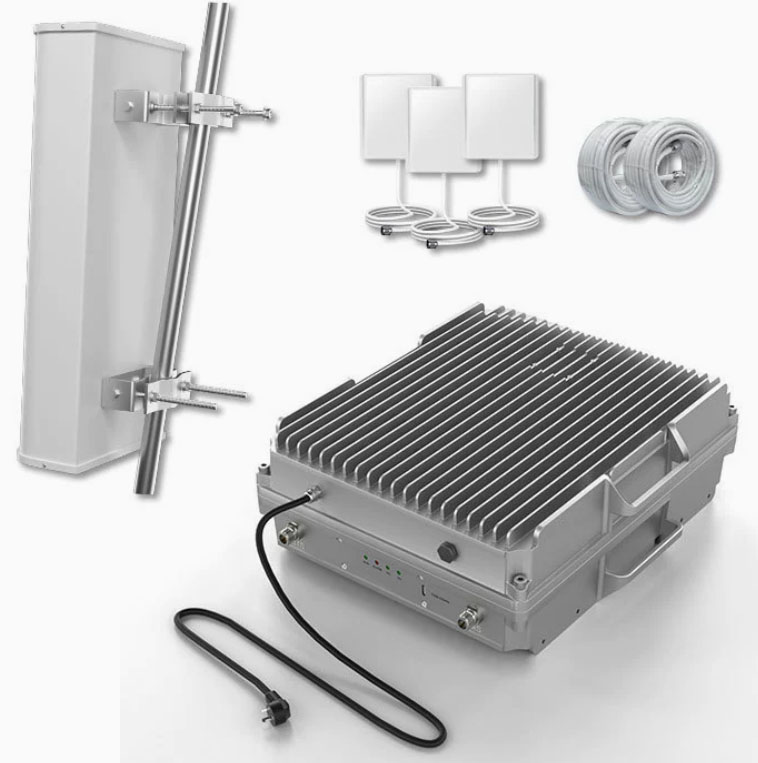
Industrial 2G 3G 4G 20W 3 Frequency Band Selectable Long Range Digital Optical Fiber Mobile Phone Signal Repeater
The Role of Fiber Optic Repeaters in Modern Mobile Networks
In the era of 5G and high-speed data, a consistent mobile signal is no longer a luxury ---it is a necessity. However, geographical obstacles and structural interference often create "dead zones." The Fiber Optic Repeater (FOR) has emerged as one of the most effective solutions for bridging these gaps, using light-speed technology to transport cellular signals over vast distances.
Technical Architecture and Workflow
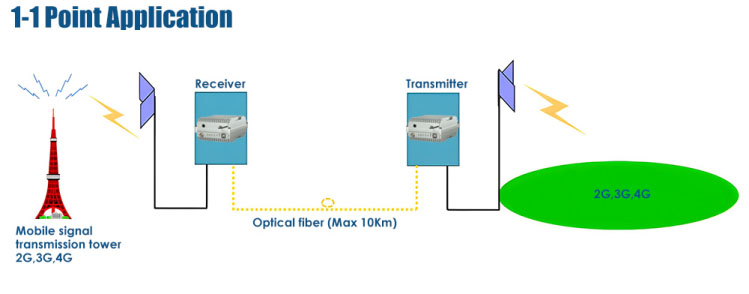
A Fiber Optic Repeater system functions as a high-tech bridge between a mobile base station and a remote dead zone. It operates through two primary units:
The Master Unit (MU)
The process begins at the Master Unit, which is typically installed near a Base Transceiver Station (BTS). It "captures" the radio frequency (RF) signals from the carrier and converts them into optical pulses through an Electrical-to-Optical converter.
The Transmission Link
These optical signals travel through a fiber optic cable. Because fiber uses light rather than electricity, the signal experiences almost zero interference and very little loss in strength, even over distances exceeding 10 kilometers.
The Remote Unit (RU)
Once the light pulses reach the target area, the Remote Unit converts them back into RF signals. These signals are then amplified and broadcast via service antennas to mobile devices in the vicinity.
Core Advantages
Extended Reach:
Unlike traditional wireless repeaters that rely on "line-of-sight" and lose strength quickly, fiber optic versions can cover massive distances. This makes them the primary choice for connecting rural villages or long highway stretches to a distant city hub.
 Immunity to Interference:
Since the signal is carried via light through glass or plastic fibers, it is completely immune to electromagnetic interference (EMI). This ensures that the data speeds and voice quality remain "clean" and stable.
Scalability and Flexibility:
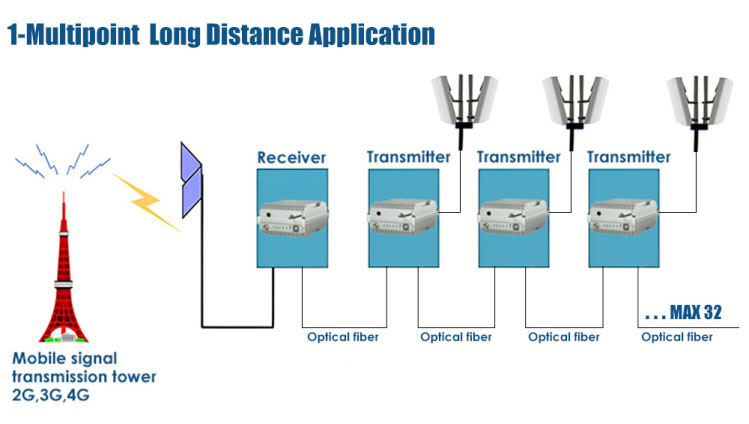
A single Master Unit can be configured to feed multiple Remote Units. This allows engineers to create a "star" or "daisy-chain" network to cover complex layouts like multi-wing hospitals or sprawling industrial parks.
 High Bandwidth Capacity:
Modern fiber repeaters are designed to handle multiple frequency bands and multiple mobile operators simultaneously, making them a future-proof investment for 5G deployment.
Typical Application Scenarios
Underground Infrastructure
In subways, tunnels, and underground parking garages, thick concrete and soil block all external radio waves. Fiber optic repeaters are essential here, as the fiber cable can be easily snaked through narrow conduits to bring signal deep underground.
Dense Urban Environments
In "urban canyons" created by glass and steel skyscrapers, signals often bounce and create interference (pilot pollution). Fiber repeaters allow operators to place antennas precisely where they are needed inside buildings or in courtyard shadows without needing a full, expensive base station.
Remote Industrial Sites
Mining operations and offshore platforms often exist far beyond the range of standard towers. By running a fiber line from the nearest network node, operators can provide full 4G/5G coverage to workers in these isolated locations.
Conclusion
As we move toward a more connected world, the Fiber Optic Repeater serves as a vital tool for network optimization. It combines the massive bandwidth of fiber optics with the mobility of cellular technology, ensuring that "dead zones" become a thing of the past.
Parameter
Value
Frequency Band
CDMA850/GSM900/DCS1800/WCDMA2100/LTE-TDD39/40/41
Installable Antenna Quantity
50-120pcs
Distance between Receiver and Transmitter
Standard 3~5Km, Max 10Km
TX Power (dBm)
37±2dBm / 40±2dBm / 43±2dBm
TX Power (W)
5W / 10W / 20W
Gain
95±2dB
Bandwidth
25M + 75M + 60M
Automatic Level Control
≤20dB
VSWR
≤1.8dB
Noise Factor
<5dB
Third-order IM
9KHz~1GHz: ≤-36dBm, 1GHz~12.75GHz: ≤-30dBm
dBP-P
<5dB
Impedance
50Ω
RF Connector
N-Female + Optical Fibre Splice
Power Supply
AC110-240V
Weight
19.6Kg
Size
430*430*180mm
The signal coverage area depends on the antennas (Quantity, Type).