
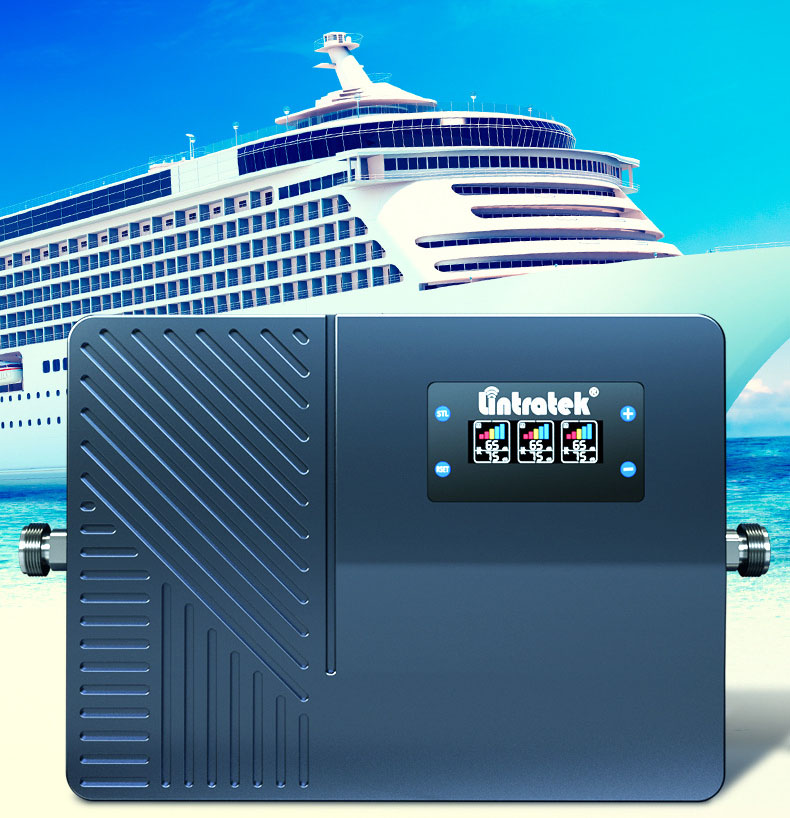
Navigating the vast oceans, mobile signals often weaken rapidly as you move away from the coastline, sometimes disappearing entirely. Whether vacationing on a yacht or working aboard a cargo ship, maintaining communication with the outside world is crucial.
This article will provide an in-depth analysis of the working principles, core advantages, and key considerations when selecting a Marine Mobile Signal Booster.
Why is Signal So Poor at Sea?
Communication challenges at sea are far more complex than on land:
Distance Barriers: Land-based cell towers have limited coverage. Signal strength diminishes exponentially as vessels venture into deeper waters.
Faraday Cage Effect: Modern ships are typically constructed entirely of metal (steel or aluminum). These metal hulls act like giant shields, blocking already weak outdoor signals from entering the vessel.
Multipath interference: Reflections and refractions off the water surface cause signal instability, resulting in frequent disconnections or choppy voice transmission.
How Marine Signal Amplification Systems Work
Marine signal amplifiers (also called boosters or repeaters) operate as closed-loop systems with a core mission: “capture, amplify, redistribute.”
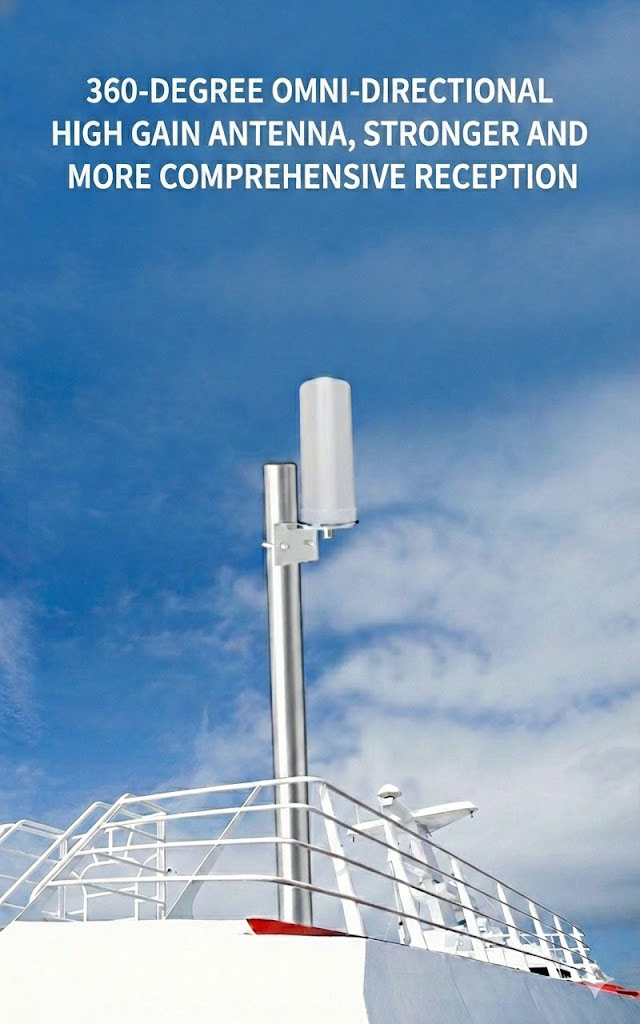
High-Gain Outdoor Antenna: Typically mounted atop the mast with an omnidirectional design to capture faint land-based base station signals across 360 degrees, even during vessel movement or turns.
Signal Host (Amplifier): The system's “brain,” responsible for low-noise amplification of captured weak signals while filtering out noise interference.
Indoor Coverage Antenna: Installed within the vessel's interior (e.g., lounge, bridge, or engine room), it uniformly distributes amplified signals to mobile devices.
Special Requirements for Marine Systems
Unlike home or car amplifiers, “marine-grade” equipment must possess the following characteristics:
1. Corrosion Resistance and Protection Rating
The marine environment is filled with salt spray and high humidity. Qualified marine amplifiers must have an IP67 or higher protection rating for outdoor components. Antennas are typically made of fiberglass to prevent seawater corrosion and UV degradation.
2. High Gain for Long-Range Reception
Since vessels may be tens of kilometers from base stations, marine amplifiers require higher gain values (dB) and output power. This enables them to “grab” signals from farther distances than standard amplifiers.
3. Multi-Band Support (Full Network Compatibility)
Crew and passengers may use different mobile carriers (e.g., China Mobile, China Unicom, China Telecom). An excellent system should support the full frequency range (700MHz to 3500MHz), ensuring both 4G LTE and 5G signals are amplified.
4. Automatic Gain Control (AGC)
When vessels approach ports near base stations, signals can suddenly become extremely strong. AGC automatically adjusts power to prevent amplifier overload or interference with base stations.
Core Benefits After Installation
Safety Assurance: Ensures mobile phones remain a critical backup communication tool during emergencies, alongside satellite phones.
Business Collaboration: Crew members can promptly receive weather forecasts, electronic chart updates, and maintain efficient communication with ports.
Psychological Comfort: During long voyages, stable connectivity allows crew to reunite with family via video or voice calls, significantly alleviating the monotony of life at sea.
Extended Battery Life: Phones conserve power by avoiding increased transmission power searches in strong signal areas.
Marine cell phone signal boosters serve as digital bridges connecting the ocean to land. For vessels frequently navigating coastal waters, inland rivers, or near-shore routes, this represents an infrastructure investment with exceptionally high return on investment.